2016年7月15日星期五

Frasers Centrepoint Trust最新派息及歷年紀錄

FCT剛公佈2016年第3季派SGD$3.04cents,符合預期。收入雖因商場裝修及個別小商場occupation rate下降而減少,派息卻略有增加。下圖表可以看到
歷年派息紀錄非常穩定上升,這是因為組合中多是民生商場有關,經得起經濟週期。買reits除了買回報率,還要揀可以長時間派息穩定上揚。


2016年7月14日星期四

投資REITS及債券的槓干融資平台

筆者開始投資香港和星加坡的REITS,也打算將來投資其他地方的REITS,構成一個房地產信託基金的組合,作為我整個投資組合的重要部份。嘗試比較不同的證券公司和銀行,希望找到一個有效率的投資平台,方便入貨,收息和管理。

我一向有用開耀x,輝x的戶口買賣港股。這兩家也有提供環球證券買賣和收息服務。自然首先考慮它們的收費。以星加坡REITS來說,耀X收0.16%(最低20坡元),佣金較平。輝X則收0.28%至0.38%(最低33坡元)。我最後選擇了耀x購入第一批新加坡REITS。結算時驚訝地發覺他們報的匯率和我在yahoo網上得的有很大出入,所以直接和盤房聯絡,要求同時報Bid 和Ask。居然spread有2%之多!忍痛結匯之餘也想想將來可能換馬,一出一入影響很大,所以又去輝x詢問他們的結匯報價,可能輝x是新加坡公司,差價合理很多。總計支出也平過耀x。

這次交了學費也很值得,以前沒有考慮兌換問題,只考慮佣金多少,原來買賣外地證券這個因素也非常重要。耀x不提供星加坡證券margin,輝立有但利息高,兩者都不是槓干融資之選。

我以前買美股時用過一間美國券商,後來無玩美股就差不多忘記了。這家公司全線上操作,香港有辦事處。平台操作多樣化,可塑性超高,但對我來說太複雜,很吃力去搞清楚每一個環節,深怕按錯掣搞錯冇哂D錢。這次我再上去操作平台看看有否作為,居然發覺有以下驚喜:

1)非美股,即港股和星加坡股收0.08%佣金(最低收HK$18或2.5坡元),澳洲日本佣金亦是0.08%,買美國REITS ETF VNQ也是US$1佣金,方便全球佈局。

2)兌換差價非常低,USD/HKD和USD/SGD的差價是小數點後第四個位。每次不論交易多少,劃一收US$2佣金。

3)Almost 所有香港和新加坡REITS margin融資可做到70%,比私銀還要好

4)Margin 融資利率低,借美金坡紙比我用開的私銀還要低
HKD 借$0 - 780,000 2.555% (BM + 2.5% )
$780,000.01 - 7,800,000 2.055% (BM + 2% )
$7,800,000.01 - 780,000,000 1.555% (BM + 1.5%)

SGD 借 $0 -150,000 (1.5% (BM + 1.5% ))
 $150,000.01 -1,500,000(1% (BM + 1%))
 $1,500,000.01 -150,000,000 ,(0.5% (BM + 0.5%))

USD 借$0 -100,000  --------------1.9% (BM + 1.5% )
$100,000.01 -1,000,000 ----1.4% (BM + 1%)
$1,000,000.01 - 3,000,000--0.9% (BM + 0.5% )
$3,000,000.01 - 200,000,000-----Greater of 0.5% or(BM+ 0.25%)

5)S&P給這證券公司評級是BBB+,展望正面,資產50億美元。評級比香港很多銀行還要高。

6)有不同topic的web-seminar可以幫助你了解操作方法,當中有英文,國語,廣東話

7)海量的資訊提供和各式操作手法,適合好學兼精力無限的投資者!

8)可買賣超過3000隻美國債券,包括國庫債券,投資級及非投資級債券,也有30-90%的融資額。(這方面操作筆者還未懂,需要多點了解,但看到投資潛力很大,畢竟債券市場比股票大)


缺點
1)轉錢入香港銀行自己戶口即時在網上做到。惟存錢入證券戶口則比較麻煩,要親身拿支票或郵寄去公司,而且一定要自己名開的支票。
2)平台不易操作,雖有中文平台,但翻譯較差,如不熟英文比較難明白。筆者也要花很多時間去掌握。總算初步識落簡單的指示和貨幣兌換,買了些新加坡REITS
3看完menu都不明白,可打電話問,香港客戶服務一般英文對答,冇廣東話,如懂國語,可打去上海問。筆者兩次電話詢問都可以解決到疑難,算是滿意的!
4)始終全線上操作,心有些不踏實,不像在香港去耀x地舖,見到摸到!

其他優點缺點,有待同好一切發掘。筆者分享這次買新加坡REITS經驗,是盼望更多融資收息朋友一起研究,補充個人的盲點。再者,筆者認識很多較年輕朋友,因未達私人銀行開戶資格而沮喪,不能進入債券REITS融資收息之門,所以希望找到到一個合適平台,讓大家參考盼望早日達到財務自由!如發現錯誤,或有更好平台,歡迎指教!😂

2016年7月7日星期四

我的新Reits 組合

經過半年的摸索,終於動手將REITS加入我的投資組合裡。先試探式每隻買入多少,然後再按個別表現調整比重。還好入市時機不太差,暫時錄得+4%回報。REITS在英國公投脫歐後,還有逆市的上升,確是出人意外,這證明現在REITS也成了資金避難所!下一個階段,會考慮加入美國、日本和澳洲的REITS。


買入Frasers Centrepoint Trust (Singapore)

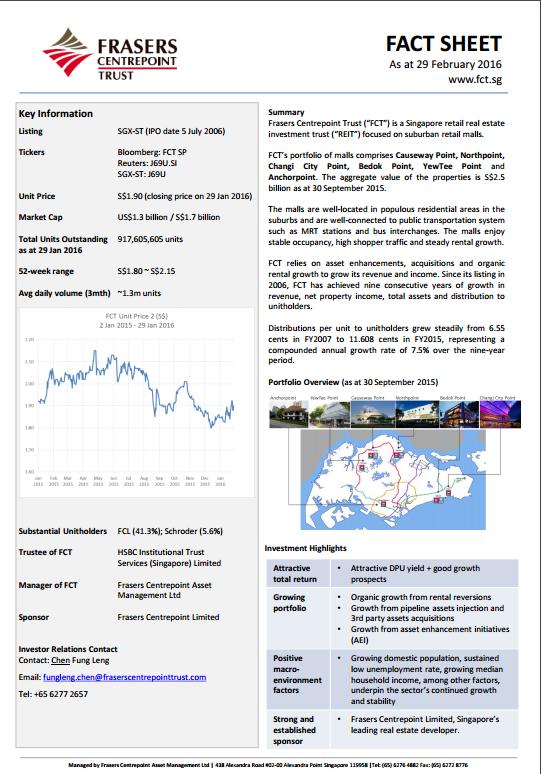
試探式買入新加坡的Frasers Centrepoint Trust@2.1(SGD),小試牛刀。買的原因是所有商場都不是位於市中心,卻在交通便捷的民生區。受經濟週期影響較少。且保持多年派息增長,yield有5.6%,也算不錯。現P/E=11.8,P/B=1.1,借貸率只28%,還有很大空間收購合適商場,提高回報率!
Frasers Centrepoint Trust 公司網站


2016年6月23日星期四

CapitaLand Mall Trust’s Annual Report: 11 Numbers Investors Should Know


By Hui Leong Chin - June 1, 2016

CapitaLand Mall Trust  (SGX: C38U), an owner of multiple retail malls in Singapore, had released its latest 2015 annual report a few months back.

The annual report is a great place to learn more about the REIT. CapitaLand Mall Trust’s report contained a list of interesting numbers. Here are 11 numbers that may be worth knowing for investors:

At the end of 2015, CapitaLand Mall Trust had 16 properties and a whopping 3,086  leases. In comparison, its peer Frasers Centrepoint Trust (SGX: J69U), another REIT which owns retail malls in Singapore, had less than 700 tenant leases.
The annual shopper traffic to CapitaLand Mall Trust’s portfolio of malls is 348 million. This is impressive, given Singapore’s population of around 5.5 million people.
CapitaLand Mall Trust’s tenant retention rate was 81.1% in 2015. This suggests that the REIT has been able to maintain a strong relationship with its tenants.
The REIT also noted that no single tenant contributed more than 4.0% of its total gross rental income as at 31 December 2015. In fact, the 10 largest tenants accounted for under 20% of the REIT’s total gross rental income.
CapitaLand Mall Trust added that around 75% of its gross revenue caters to the necessity shopping segment. This may add resilience to the REIT’s portfolio during downturns.
The REIT’s loyalty programme, CAPITASTAR, boasts over 2.6 million members across five countries. There are more than 800,000 members in Singapore.
Moving on to debt, CapitaLand Mall Trust’s average term to maturity of its borrowings is 5.3 years. This is an increase compared to the 2.3 years to 4.7 years that were seen from 2011 to 2014. The REIT’s average cost of debt has also been relatively stable, hovering between 3.3% and 3.5%. In short, CapitaLand Mall Trust has been able to lengthen its debt term without incurring higher cost of debt.
A full 100% of CapitaLand Mall Trust’s debt is also unencumbered. Said another way, the REIT has not had to put up its assets as collateral when it borrows money. This is a major change from 2012, when only 50.4% of its debt was unencumbered.

2016年6月22日星期三

Broker's Report RHB likes Singapore retail and hospitality REITs; neutral on office

SINGAPORE (June 22): RHB is maintaining its “neutral” stance on the office sub-sector of Singapore REITs as it expects spot rents to fall further.

According to Knight Frank, premium Grade A+ office rents (Marina Bay/Raffles area) fell 3.6% q-o-q during 2Q16 to $9.88 psf from $10.25 psf in the previous quarter. The latest drop also marks the fifth consecutive q-o-q drop since the recent peak in 1Q15 at $11.49 psf.

The fall in office rents in the Marina Bay/Raffles area doesn't come as a surprise as the office sector has been grappling with supply glut issue since early 2015, says analyst Vijay Natarajan of RHB in a Wednesday note.

“We expect the supply-demand dynamics to remain unfavourable in the near-term as an average about 2 million sf  of office space is expected to be completed in the next three years compared to 10-year average demand of 1.2 million sf,” says Natarajan.

However, the office REITs sector currently trades at a high FY16 dividend yield of 6-7%, which would provide support to its share price.

Still, Natarajan likes the resilient local retail sub-sector as rental positive reversions are likely to persist. It also likes the hospitality sub-sector as there is an increasing number of new events in 2016.

“Our top picks are Ascendas REIT (Buy, Target price: $2.63),CapitaLand Mall Trust (Buy, Target price: $2.36), Frasers Centrepoint Trust (Buy, Target price: $2.22) and OUE Hospitality Trusts (Buy, Target price: $0.86),” says Natarajan.

2016年6月8日星期三

5 Important Factors You Need to Consider Before You Invest in Any REIT


If you’re looking for passive income, then investing in stocks that pay you a stable and growing dividend is something that you need to keep your eye open for. In that vein, REITs are great investments if you plan to invest for stable, passive income. Why so?
  • Firstly, REITs (or real estate investment trusts), as their name suggests, invest in real estate. And in land-scarce Singapore, property in general makes for a great long-term investment. Our country is also safe, politically stable, and well run (although some of us would disagree!) which means the value of our real estate is likely to hold and appreciate over time. And although many of our REITs also invest in assets overseas, most of them own properties that are mainly located in Singapore.
  • Secondly, REITs pay a high dividend yield. There are currently 35 REITs listed in Singapore with an average dividend yield of 7.5% (as at Feb 2016). With the current market downturn, some REITs have yields as high as 10% right now! One of the main reasons why REITs offer such high yields is because they enjoy tax-exempt status as long they pay out at least 90% of taxable income to shareholders. The tax breaks and high payouts mean higher yields for investors. The recent 2015 Singapore budget extended tax breaks for REITs for another five years.
  • Thirdly, REITs also pay their dividends (or distributions) four times a year. In comparison, a typical company usually only pays dividends once or twice a year. So if you’re an investor who wants to receive a steady, regular stream of passive income throughout the entire year, REITs will do very well for you.
So now that we’ve established that REITs offer a high, steady stream of passive income for investors, what are the important factors you need to look at before you invest in any particular REIT?
Here are five important factors you need to consider:

#1 Type of Industry

Not all REITs are made the same. Singapore REITs fall into six broad categories: office, retail, residential, healthcare, hospitality, and industrial. Each sector has its own specific characteristics that will affect a REIT’s growth, risk profile, and performance.
For example, office REITs like CapitaCommercial Trust, own office buildings. During a bull economy, businesses do well and demand for office space is high. This translates to higher rents and property income for the REIT. During a recession, the chips fall the other way – some businesses go bust, demand tumbles and office rents fall in tandem. The economic cycle largely affects the performance of an office REIT.
On the other hand, retail REITs like Starhill Global own shopping malls. Even in times of recession, many malls are usually still packed with shoppers and shop spaces are fully tenanted. Demand for retail space remains high which means rents and property income for the REIT barely drop.
Starhill Global SG Retail Occupancy Rate
All things equal, investing in a retail REIT is less volatile than investing in an office REIT. Of course, investors are aware of this and hence generally willing to pay higher prices for a retail REIT which lowers your dividend yield.

#2 Dividend Yield

This is probably the first ratio that every investor looks for when investing for dividends. While everyone enjoys a high dividend yield, what’s more important is to examine a REIT’s dividend track record.
Does a REIT pay a stable or rising dividend per share (or distributions per unit) year after year? Or does it tend to fluctuate every year?
A REIT that’s able to steadily grow its income and dividend per share year after year is understandably a more attractive investment than a REIT whose dividend payouts fluctuate all the time.
ParkwayLife REIT DPU 2007-2015
A REIT with a higher dividend yield doesn’t necessarily mean that it’s a “better” investment. For example, an office REIT usually has higher yields compared to a retail REIT, but office REITs are also more volatile and less resilient than retail REITs.

#3 Property Yield

Property yield is the amount of income a REIT can generate from a property. For example, if a property is worth 10 million dollars and earns $400K in rent in one year, then its property yield is 4%. Understandably, the higher the yield, the better. But what’s more important is to examine whether a REIT’s property yield is stable or rising over the years. A well-managed REIT will look for ways to continually improve its property yield.
SPH REIT Property Yield
Source: SPH REIT
One common way for a REIT to improve its property yield is to acquire yield-accretive properties. For example, if a REIT’s property yield is 4% and it acquires a new property that generates a 5% yield, the new acquisition will help to increase the REIT’s overall property yield.

#4 Gearing Ratio

Gearing ratio represents a REIT’s amount of debt over its total assets. The higher the ratio, the more debt a REIT has.
In Singapore, REITs are tightly regulated and only allowed to borrow up to 45% of their total assets. So if a REIT owns a billion dollars in assets, it can only borrow up to $450 million in loans. A REIT can borrow the money to fund new acquisitions for growth, upgrade its buildings, etc.
MCT Gearing 2011-2015
The lower the gearing ratio, the more conservative a REIT is. At the same time, a high gearing ratio does not necessarily mean that a REIT is a poor investment – it just means that a REIT is willing to take on more debt (and risk) for growth.

#5 P/B Ratio

P/B ratio measures a REIT’s share price against its net asset value (NAV) per share. Theoretically, a P/B ratio of 1 indicates a fair valuation. A ratio above 1 means a REIT is overvalued and a ratio below 1 means it is undervalued.
For example, if a REIT’s share price is $1 and its NAV per share is $2, then its P/B is 0.5 – essentially you’re only paying 50 cents for every dollar of net assets.
CMT PB Ratio
In practice though, you shouldn’t simply rely on P/B alone to value a REIT. Other important factors, like the ones we’ve discussed above and more, must also be taken into consideration when choosing to invest in a REIT.
While REITs in general are great investments for dividends, not all REITs are equal – it’s important to pick only the best-managed REITs that are able to pay you a long-term growing dividend and appreciate in value over time.
SG REIT Yield
Singapore REITs Historical Yield. Source: DBS Bank

Finally, if you’re a REIT investor and you’d like a quick way to view and compare all the above ratios at one glance, check out our free Singapore REIT data service where we list all this data and information for investors.